

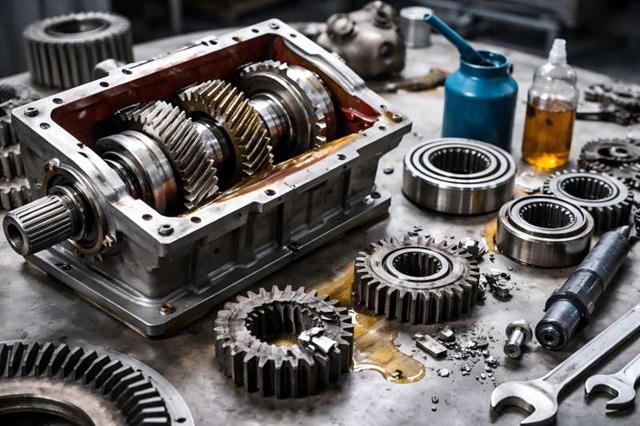
Gearbox repair services represent one of the most technically demanding disciplines in automotive maintenance, and understanding why they matter so much requires us to think carefully about what a gearbox actually does. Much like the intricate social systems that allow complex civilisations to function, the gearbox is the mechanism through which raw engine power is translated into controlled, purposeful movement. When it fails, the entire system breaks down.
This is not merely a mechanical inconvenience. It is a cascade of consequences that any driver who has experienced a slipping transmission or grinding gear change will recognise immediately. To understand how to address these failures, we must first understand how they arise.
Why Gearboxes Fail: A Systems Perspective
No mechanical system operates in isolation. The gearbox is subject to heat, friction, pressure, and the slow accumulation of wear that comes with every kilometre driven. In Singapore’s urban driving conditions, where stop-start traffic places repeated stress on the transmission, this deterioration accelerates considerably.
The most common causes of gearbox failure include:
- Insufficient or degraded transmission fluid, which reduces lubrication and causes internal components to wear prematurely
- Worn synchroniser rings, which are responsible for smooth gear engagement and are particularly vulnerable in vehicles with high mileage
- Damaged gear sets or bearings, often caused by prolonged neglect or sudden mechanical shock
- Faulty solenoids, which control fluid flow in automatic transmissions and can cause erratic shifting behaviour
- Torque converter problems, which in automatic gearboxes can produce shuddering, overheating, and loss of drive
Each of these failures follows a recognisable pattern. They rarely arrive without warning. The challenge, as with so many complex systems, is learning to read the early signals before minor damage becomes catastrophic.
Recognising the Warning Signs
One of the most instructive things about gearbox problems is how consistent the warning signs are across different vehicle types. Whether you drive a manual or automatic transmission, the symptoms follow a logical sequence.
Common indicators that gearbox repair may be needed:
- Difficulty shifting gears, or gears slipping unexpectedly
- A burning smell, particularly after extended driving in heavy traffic
- Unusual noises such as grinding, whining, or clunking during gear changes
- Delayed engagement when shifting from park to drive in automatic vehicles
- Transmission warning lights appearing on the dashboard
- Visible fluid leaks beneath the vehicle, often reddish in colour
In Singapore, where vehicles are subject to demanding daily use and high ambient temperatures, these symptoms tend to develop more rapidly than in cooler climates. Transmission fluid degrades faster under heat, which makes regular inspection particularly important here.
Understanding the Repair Approaches
Gearbox repair is not a single procedure. It encompasses a spectrum of interventions, each appropriate to a different level of damage. Understanding this spectrum helps vehicle owners make informed decisions rather than accepting unnecessary work or, conversely, delaying repairs that are genuinely urgent.
Fluid Replacement and Servicing
At the most straightforward end of the spectrum is transmission fluid replacement. In many cases, particularly where problems are caught early, draining degraded fluid and replacing it with the correct specification can restore smooth operation and extend the life of the gearbox considerably. This is analogous to treating a chronic condition through dietary change rather than surgery: effective when applied early, far less so when applied too late.
Component-Level Repair
When specific components have failed, targeted repair becomes necessary. This might involve replacing worn synchroniser rings in a manual gearbox, rebuilding a faulty torque converter, or replacing damaged solenoids in an automatic transmission. Component-level gearbox repairs require a skilled technician with access to the correct parts and diagnostic equipment, and the quality of the repair is heavily dependent on the precision with which it is carried out.
Full Gearbox Rebuild or Replacement
In cases where damage is extensive, a full rebuild or replacement is the appropriate course of action. A rebuild involves completely disassembling the gearbox, inspecting every component, replacing all worn or damaged parts, and reassembling the unit to factory specifications. This is a labour-intensive process, but when done properly, it restores the transmission to a condition that can match or approach its original performance.
Replacement with a reconditioned unit is sometimes the more practical option, particularly where labour costs for a full rebuild would exceed the value of the vehicle or where turnaround time is a priority.
The Importance of Preventive Maintenance
The most important insight that emerges from studying gearbox problems across many vehicle types and driving environments is this: prevention is substantially cheaper than repair. Regular transmission fluid checks, timely servicing, and attentive driving habits collectively extend gearbox life in ways that no repair, however skilled, can fully replicate.
In Singapore specifically, where vehicle ownership costs are significant, protecting major mechanical components through consistent maintenance is not merely sensible. It is economically rational. A transmission that is serviced regularly is unlikely to require a full rebuild. One that is neglected almost certainly will.
Conclusion
The gearbox is a system of remarkable complexity, and the factors that lead to its failure are as varied as the vehicles that carry them. But the principles governing its care are consistent: understand the warning signs, respond to them early, and invest in regular maintenance before problems compound. For anyone navigating the realities of vehicle ownership in Singapore, quality Gearbox repair services remain not just a technical necessity but a long-term investment in the reliability and longevity of the vehicle itself.